It has been a while since I published one of these. I would love to tell you the silence was due to a month-long spiritual retreat in a remote monastery, but the truth is far more mundane. Mostly, I have been trying to figure out exactly how many grams of coffee belong in a refillable pod without triggering a structural revolt from a Swiss espresso machine, and navigating the endless, self-replenishing conveyor belt of administrative logistics that makes up a modern Tuesday.
But I want to write more, because it feels like we are living through a bizarre, tectonic cultural shift, and if we don’t write it down, we might forget how strange it all was.
If you read the headlines, this transformation is entirely about AI, silicon chips, and large language models. But on the ground, in the actual physical territory of our lives, the shift is much weirder. Just look at us. We walk around in moisture-wicking, aerodynamic, thermal-regulated quarter-zips to sit in ergonomic chairs and send emails. We are a people dressed for a winter ascent of K2, currently attempting to conquer our inboxes. We have optimized our gear, our diets, and our sleep scores, but I am starting to wonder what it is we actually savor.
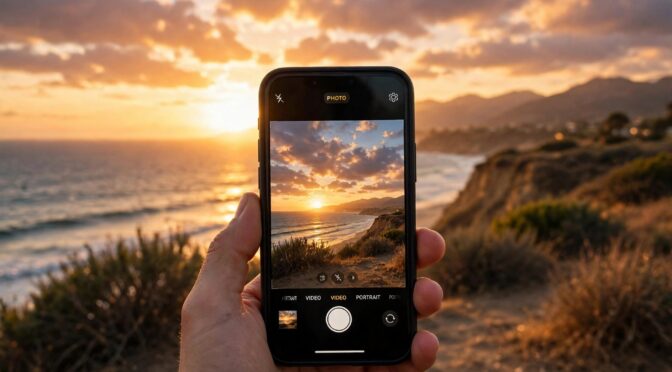
Take the sunset. The other evening, the sky over the Pacific did that specific thing where it turns the color of a bruised peach and seems to demand absolute, physical silence. But we don’t do silence anymore. Instead, if you look down the coast, you will see a dozen people holding up glowing glass rectangles, frantically swiping at exposure settings. We take the sheer, terrifying majesty of the cosmos and try to force it through a digital filter so we can harvest forty “likes” from people we haven’t spoken to since high school.
It is the transactionalization of awe. We are terrified of experiencing something beautiful and just keeping it to ourselves. If it isn’t documented, optimized, and leveraged for social capital, we worry it didn’t happen.
And I think this is exactly why we are currently starving for grace. Grace is the hardest concept for the modern mind to grasp because it is magnificently, stubbornly inefficient. It defies the logic of the world we have built. We live in a ledger-based society—everything is an exchange, a debt, a favor owed, a metric tracked.
But grace doesn’t scale. It is the guy on the 101 who lets you merge when he legally had the right of way. It is a thirty-minute conversation with a friend about a sprained wrist that produces absolutely zero economic value. It is the unearned, un-optimized space between two people. You cannot put it on a spreadsheet, which means the modern world doesn’t quite know what to do with it.
If you want to hear this tension out loud, listen to the Moonshots podcast. The hosts are the titans of Silicon Valley, guys like Peter Diamandis and Salim Ismail, and they speak about the future with the terrifying, unblinking cheerfulness of men who have just solved the math of the universe. They talk about infinite abundance, automated robot workforces, and curing aging as if these are just software patches downloading in the background.
And let me be clear: if you don’t think this technology is arriving, and arriving fast, you are driving looking in the rearview mirror. They are right about the raw capability of what is coming.
But as I listen to them, I get this sinking feeling that they are entirely willing to leap right over the actual human experience. In their worldview, everything is a certainty, a solvable equation. They want to colonize Mars and merge with the cloud, but I get the distinct sense they would be completely lost trying to figure out what to do on a rainy Tuesday afternoon in San Luis Obispo if their Wi-Fi went down.
The ultimate technologists look at the friction of human life—the miscommunications, the physical fatigue, the standing in line at the grocery store, the ambiguity of a new relationship—and see a latency issue to be engineered away.
But you cannot optimize the experience of watching your kid hit a golf ball. You cannot A/B test a moment of quiet gratitude. The friction isn’t a bug in the system. The friction is the system. It is the only place the sublime actually lives. I am trying to remind myself to look up from the dashboard, put the phone in my pocket, and just let the un-optimized present be enough.